Part 1 Section 11 of the Milan Art Institute Mastery Program
The dreaded cityscape… at least I was dreading it. I don’t know, there’s just something about drawing or painting buildings that makes me go, “eh, not for me.” Well, it just so happens, that I’m no so bad at drawing and painting cityscapes. It’s still not something I’m excited about, but it’s something I don’t really mind as much.
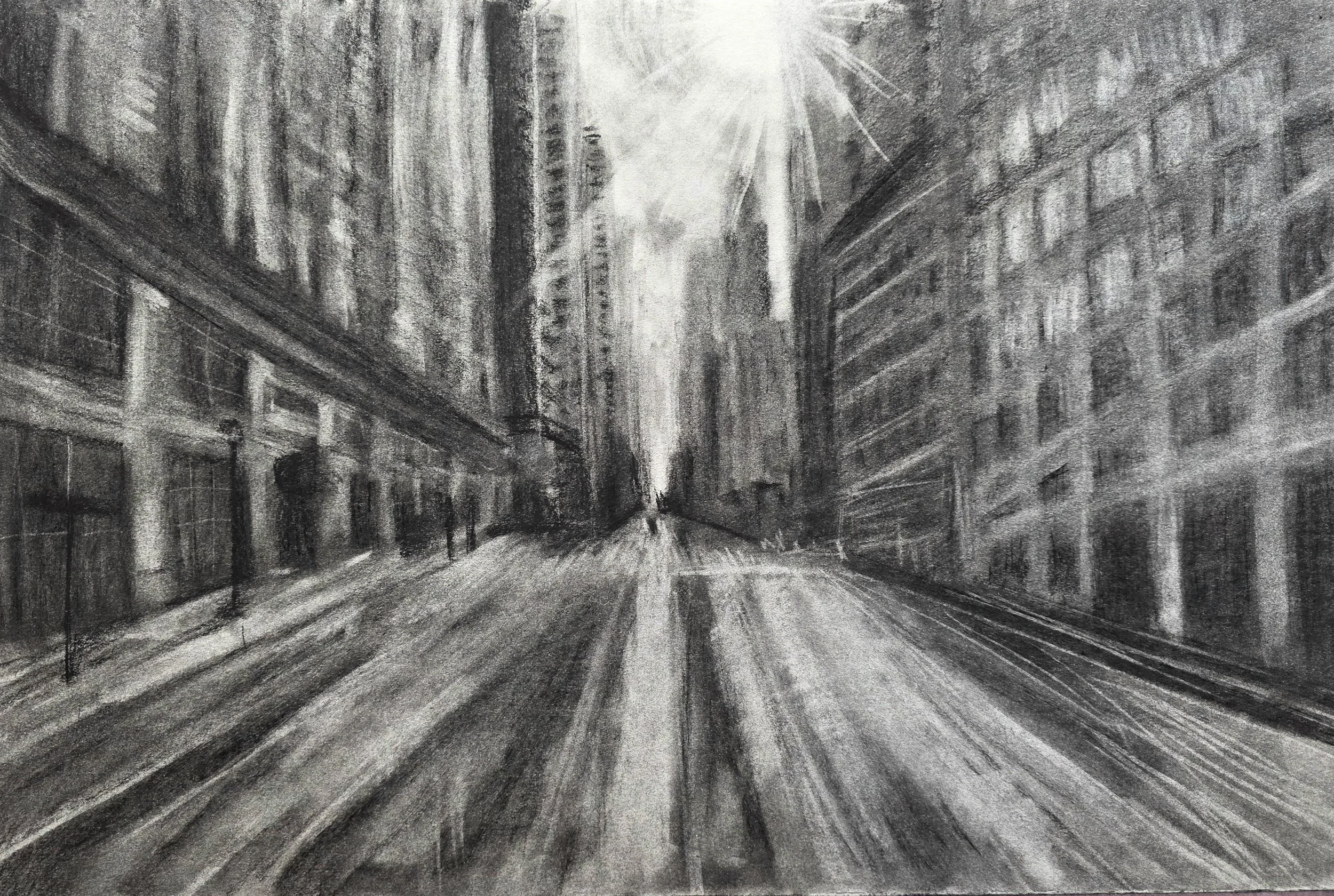
A city street in charcoal.
For the charcoal drawing, I worked on a larger sheet of Strathmore Drawing Paper. I taped off the edges so that the drawing was approximately 11.5” x 17”. Once again, I do love working in charcoal. I like the dark expressive marks you can make. What I don’t like, is the mess. I had purchased a small handheld vacuum and it’s really been helping control the charcoal and eraser dust.
For this section in the Mastery Program we had a guest instructor, HSIN-YAO TSENG. He’s an incredible artist, I’ve linked his website, if you have a minute I highly recommend checking out his work. I really enjoyed his lesson on the charcoal portion. He made drawing a complex subject, like a city, a very approachable task.
The oil painting, well that’s another matter. He has a unique style. I find his work incredibly beautiful. But the way he taught was different from the way I’ve been learning. And that’s to be expected. He’s a guest instructor, not a Milan instructor. And it’s probably because I’ve been finding oil paint a little bit of a challenge to work with anyway, I didn’t feel like I was understanding his process. To me, it looked a little messy. So instead, I went to the older version of the Mastery Program. Since I purchased the program before the updated version was released I still have access to all the older content. I went and found the cityscape oil painting lessons and worked from those instead.
Elli walks you through the familiar three stage process I’ve been doing. And maybe I should have just tried Hsin-Yao Tseng’s techniques, he’s a living master afterall, but I knew that if I didn’t like my result, I would have felt compelled to fall back on the older lessons anyway. Since I’m trying to finish all of Part 1 of the program by the end of the year I opted to do the older lessons. I’m so happy I did!
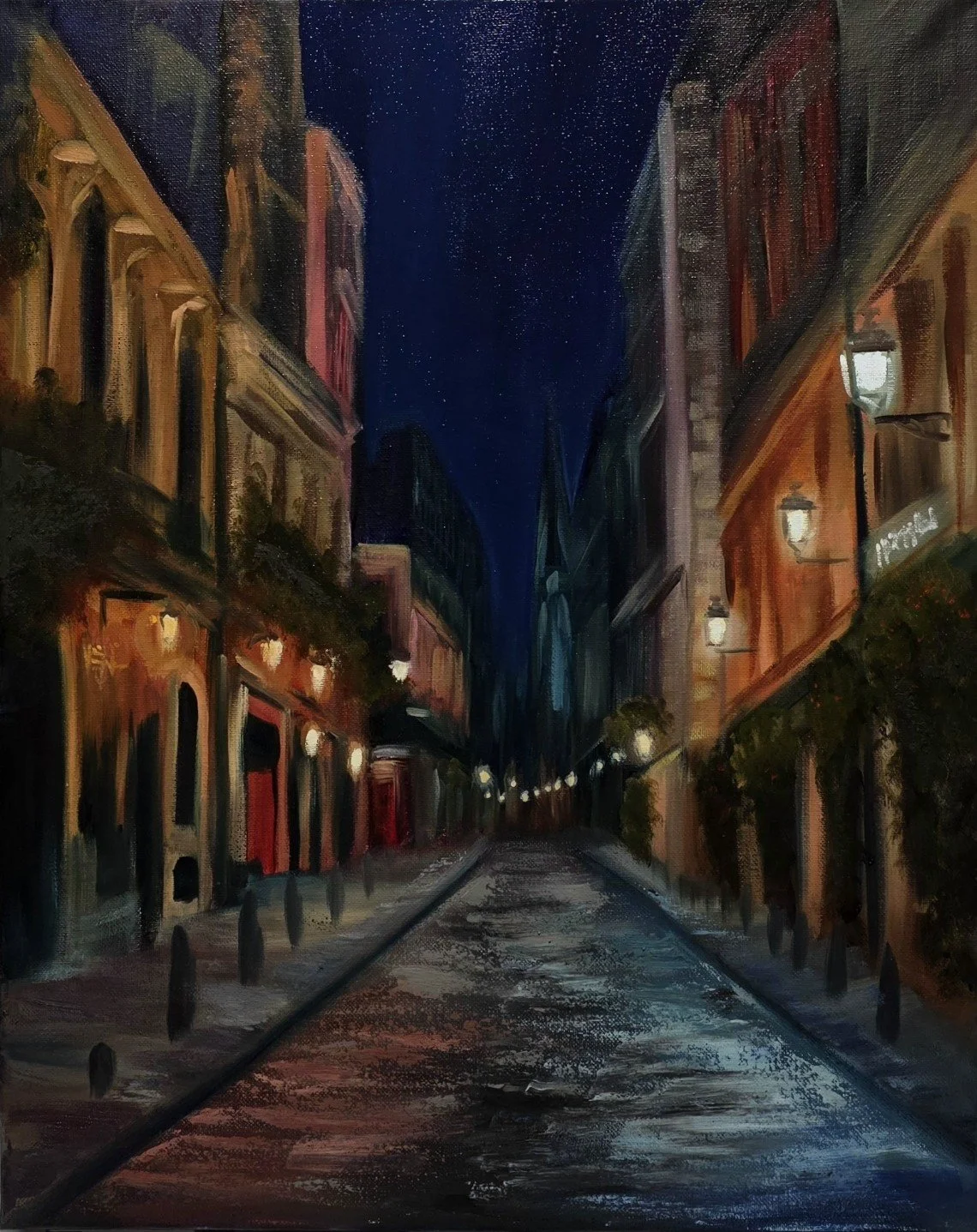
An oil painting of a city street at night.
I’m very please with my finished painting. Also, it’s the first painting I’ve done that my Mom “hinted” she would like as a present. I’m beyond thrilled that she liked this painting so much she wants to hang it in her home. I’ve already ordered a frame for it.
But let’s talk about the painting. In the previous section we learned that it’s okay to simplify compositions. So, I simplified a lot in this composition. The details on the buildings were very complex. And if I was working really large and had all the time in the world, I would have attempted to include more detail. Since this is a 16” x 20” canvas, I used my artistic license to paint my impressions of the details. And there was something very satisfying about painting the buildings in the background. The almost fuzzy, vertical strokes of the paintbrush were very soothing to me. Does that sound weird? Probably. But it’s a true story.
But the best part of the whole painting was painting the lights. That’s the reason I chose the source image. I wanted to practice painting light. I can see myself using glowy lights in future paintings. Think magical, whimsical aesthetic.
And the final part of the painting that brought me a lot of joy is the texture on the street. In the source it’s a cobblestone road. I had no idea how I was going to achieve that look without painting individual cobbles. And then it hit me. Cold wax medium. I had never used it before but it’s been mentioned in a previous lesson. So I grabbed my little jar, scooped out a little wax, mixed it with a little paint, and then spread it on the canvas with a palette knife. Oh boy was that fun! You can’t predict what the outcome will be but if you adjust the pressure as you drag the flat of the knife across the canvas you can control how much you deposit. It ended up being just what I need to get the feeling of cobblestone. Ok sure, it doesn’t really look like cobblestone, but you know there’s texture on the road that’s bouncing back those reflections. I also ended up using a little on the plants along the sides of the buildings, but it’s not really noticeable.
Well folks, there you have it. Cityscapes aren’t so scary after all. Who knew?