Part 1 Section 11 of the Milan Art Institute Mastery Program
Watch on YouTube
Ah realism. The art of creating a drawing or painting that looks like you could reach out an pluck an object right off the canvas. It’s a skill that not a lot artists take the time to develop. Some may think that there’s no point since cameras exist and you could simply take a picture. How much more realistic can something get than a photograph? And there are other artists that spend their whole artistic career perfecting realism, taking it to the extreme into hyper-realism.
I used to be one of those artists that wanted my drawings to look as realistic as possible. Eventually I thought that I was spending more time replicating something than actually creating an artistic piece. It’s a hot topic in the art world. Is realism real art? Is it worth spending all your time building technical skills but not exercising your creative muscle? I don’t know what the answer is. This is something every artist has to answer for themselves.
But for this section in the Mastery Program is was all about realism. We started with a trompe l’oeil (pronounced “tromp loy”). It’s a fancy French term that means “deceive the eye” or “fool the eye”. You find a few small random objects like torn pieces of paper, dried flowers, feathers, basically anything you can tape to a piece of paper. You then arrange your composition and tape down all of your little treasures. And voila! You have a trompe l’oeil composition. Now comes the tricky part. You have to draw your composition as realistically as possible. A trompe l’oeil is typically drawn at a 1:1 ratio so that it “fools the eye.” This requires a lot of measuring. And I mean a lot.
Right at the start I struggled. I was too much in my head about what I was going to tape down to my sheet of paper. I don’t really keep cool little random bits of things around. I started browsing Amazon for vintage papers, stamps, stickers, anything I thought would make a cool composition. Thankfully, I reigned it in. I did not need to spend money on this. I’m sure if I rooted around my studio I could have some up with something eventually. But it was keeping me from starting. So instead, I decided to just print off the source image they provided. Admittedly, I think I took the easy way out. It’s much more challenging to draw from life. Taking 3D objects and converting them to a realistic 2D image is almost sorcery. And I really would have appreciated a challenge. But it was more about getting myself to just start. I needed to get going on this drawing so that I could start my oil painting.
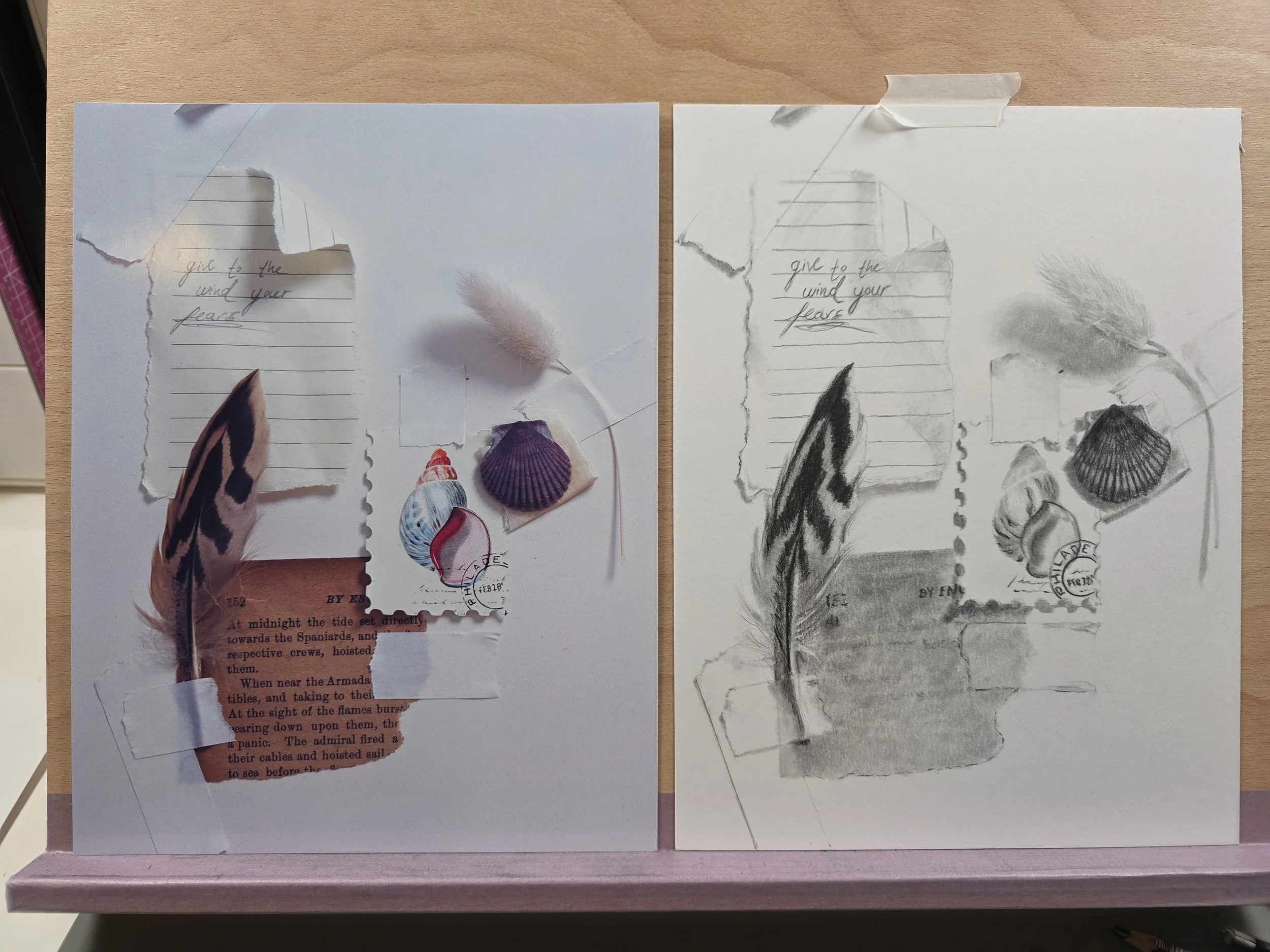
My attempt at a trompe l’oeil graphite drawing.
So I used a source that was provided. I’m very pleased with my finished drawing. All in I spent over four hours on this assignment. I don’t know that anyone would look at this drawing sitting on my desk and think they could pluck the feather off of the page, but it does look pretty good.
Now, on to the oil painting.
Let’s talk about the canvas for this assignment. I used an 11” x 14” canvas panel, the largest size recommended. I also gave my panel a thin coat of soft gloss gel to make it less “thirsty.” Since we’re going to be adding such fine detail you want your surface to be a smooth and as rigid as possible. At least, that’s what Elli said. And since she’s the boss I listened.
The source I selected for this assignment was one of the few they had that depicted nature. I just really wanted to paint plant life. And I do enjoy painting roses. The other sources were basically still life compositions. They were pretty but I just didn’t want to paint a still life. I was really drawn to the nature scene.
Painting realism in oil is a whole new beast for me. I’m already struggling with the layering process. But I think something finally clicked. I actually didn’t struggle with my layers this time. I don’t feel like my paint got overly “mushy.” I think I’m starting to get then hang of this stuff. It really clicked when I was on my fourth and final layer. Adding all the fussy detail was surprisingly relaxing for me. I was not stressed at all about the outcome of the painting I was just enjoying the process of loading my brush with paint and applying it to the canvas.
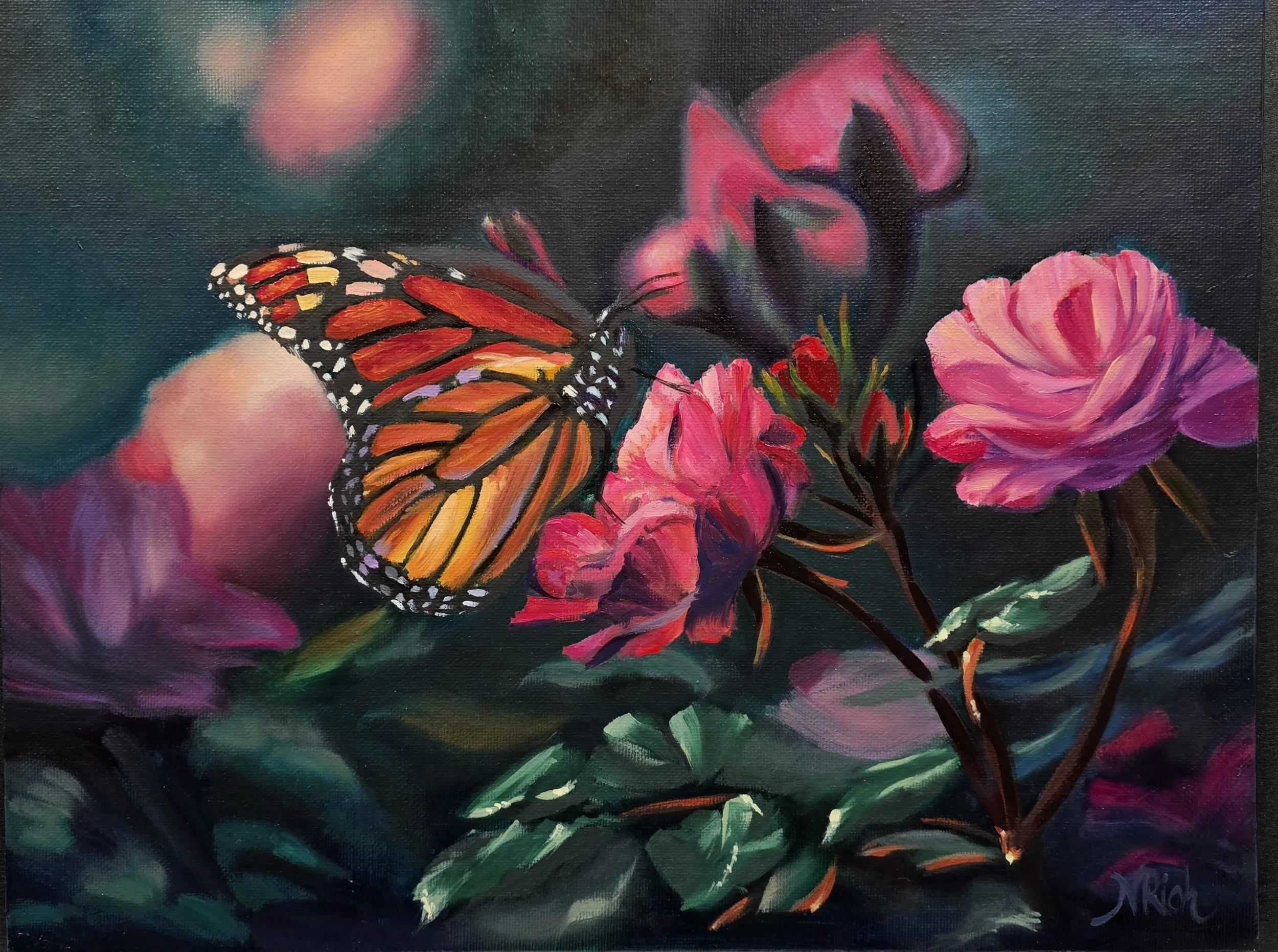
A realistic oil painting of a butterfly on a rose.
I’m mostly happy with the finished painting. Although, I’m not sure it’s 100% finished. If I’m being truthful I think it really does need another layer or two. The rose on the right needs to be pushed back a little. I can achieve that with a thin oil glaze of alizarin crimson. The roses even further back could do with the same treatment. Also my butterfly is a bit too bright, some areas in the wings could do with a glaze to tone it down a little too. And while I can see what still needs doing I can also admit that it’s a pretty painting.
I’m not sure if I’ll do the extra glazes. I could leave this painting as is and still be ok with it. If I have time while working on the next oil painting I might add the extra layers. But I really do need to move on to the next section.
So what do you think about realism? Is the skill of being able to make something look realistic an artform in itself? Or is just a technical skill? Or do you think it’s a waste of time when you could just take a picture? I genuinely want to know.